
Massillon City Directory Holdings
The best starting point for old Massillon directories costs nothing. The Massillon Memory collection is hosted through Ohio Memory. It gathers scans and transcriptions of city directories alongside yearbooks, atlases, postcards, and the Rotch-Wales papers. Its directory material names people and businesses across Massillon and Stark County. Treat it as a selection, though, not a complete year-by-year run. Before deciding a name is missing, note the exact title. Also note the publication year of each volume searched.
The local sequence itself runs unusually long. It opens with C. S. Williams's combined 1859-60 Canton and Massillon guide. It then continues through selected Burch, Potter, Spidle, Rubright, and Ohio Bell volumes. Some editions reach into nearby towns or wider parts of Stark County. That broader reach helps when a family lived near the city line. Still, the title page is the best evidence. It shows where the publisher intended the book to apply.
| Collection | Years | Where held | Access |
|---|---|---|---|
| C. S. Williams city guide | 1859-1860 | Massillon Memory | Free digitized volume |
| Burch and Potter directories | 1876-1877; selected 1884-1945 editions | Massillon Memory and local collections | Digitized selection; ask about undigitized volumes |
| Spidle and Rubright directory | 1900-1901 | Massillon Memory | Free digitized volume |
| Ohio Bell telephone directories | 1922; selected 1925-1947 editions | Massillon Memory | Free digitized volumes |
| Annual and local history materials | Scope varies | Massillon Public Library and Massillon Museum | Library visit, specialist appointment, or museum request |
A digital gap does not mean Massillon went unlisted that year. It means only that the digitized selection lacks the volume. The Massillon Public Library offers in-person or staff-assisted fallbacks. The Museum does the same for a missing year.
The Massillon Memory directory collection view displays below. Use it to pick a year and publisher before opening any volume.
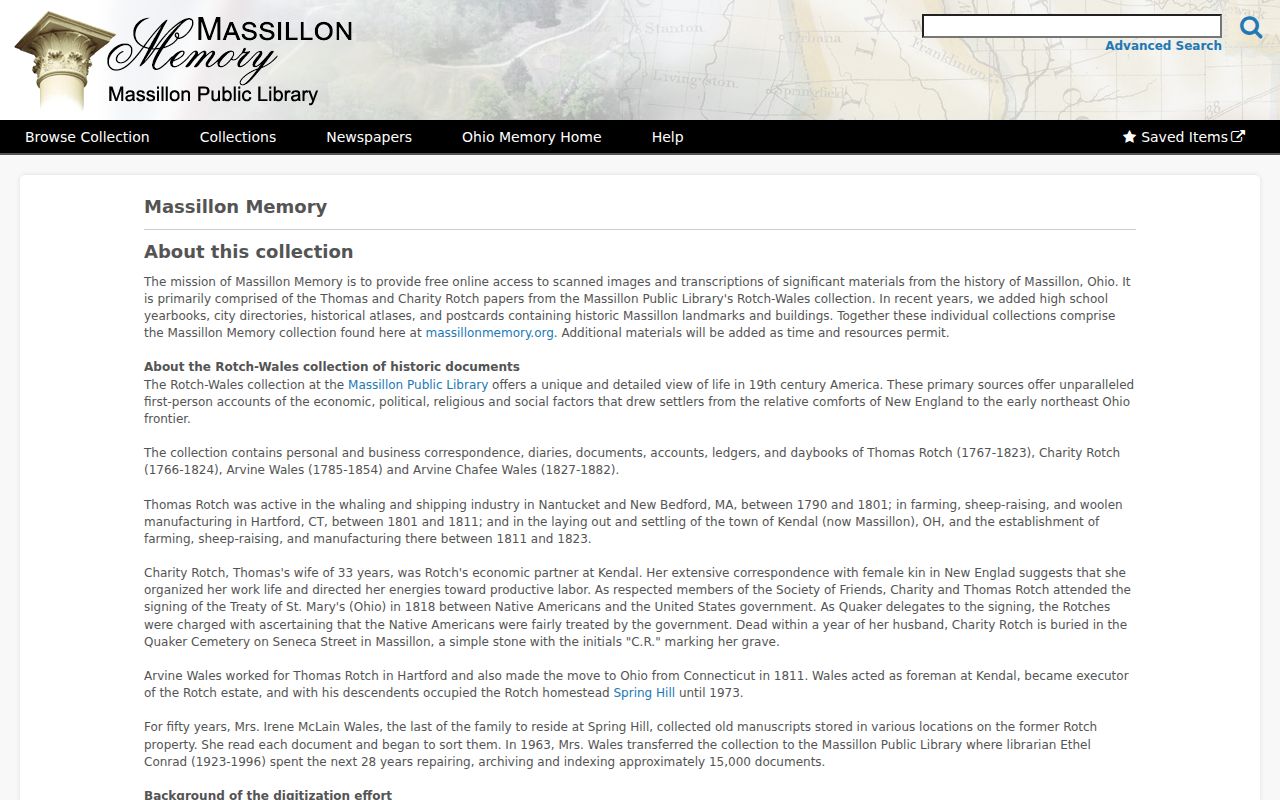
Treat the collection as a catalog of available editions. Copy the title, date, and page reference with every name or address you extract.
Massillon Memory Directory Volumes
A search of Massillon Memory returns 24 digitized directory items. That figure describes the online result list. It is not a full inventory of every book ever issued for the city. Each item record adds useful context beyond the title. This includes the collection, source call number, submitting institution, original date, rights statement, and page navigation.
Ohio Bell's 1922 volume shows why edition details matter. Its object record names the Ohio Bell Telephone Company. It dates the original to February 1922, counts 32 pages, and lists the Massillon Public Library call number. The directory covers Massillon and also names Canal Fulton, Dalton, and Navarre. It supports local leads. But the broader title keeps it from being read as a Massillon-only roll.
The 1922 Ohio Bell directory record appears in the image below. It links an object page to its catalog details. That comes before a reader opens the scanned pages.
Cite the source from the object record, then transcribe the printed line exactly as it stands. A telephone directory may carry a residence mark, an address, or a number, but it proves neither ownership nor every person in a household.
Note: The 1922 title covers nearby communities, so keep its stated geographic scope with each extracted entry.
Reading A Massillon City Directory
An entry proves only what its publisher printed. In the 1922 Ohio Bell volume, one scanned line can hold a surname, a given name or initial, and a business or occupation reference. The same line can also carry an r residence mark, a street number and name, and a telephone listing. The legend nearby explains that r after a name means a residence. An asterisk, by contrast, marks a private branch exchange. Record a mark only when that volume's legend is visible.
| Person name | Copy the surname, given name, and initials as printed, including spelling variants. |
|---|---|
| Residence mark | In the verified 1922 Ohio Bell material, r designates residence. |
| Street and number | This is the printed address for that edition, not a current parcel or ownership finding. |
| Telephone or business detail | A number, classification, service, or business cross-reference may appear when printed. |
| Street-page fields | The 1940 Burch street pages show a street header, intersections or side designations, house number, occupant or business, and sometimes a telephone. |
- Criss-cross directory
- An address-ordered section used in some directories. No Massillon volume was verified under that label; the Burch street pages are the documented historic address-to-occupant route.
- Householder index
- An index organized around the listed household name. Do not assume an edition has one unless its pages show it.
- Abbreviation key
- The printed legend that explains symbols and shortened words. Photograph or note it before interpreting an entry.
The Massillon Memory directory search narrows the available titles. It appears below as a source screen, not as proof that every result carries the same entry fields.
For an address search, the 1940 Burch street pages are the format to use. For a named person, read the personal pages and their local key first. Only then treat a mark as a residence clue.
Massillon Library Research Routes
The Massillon Public Library's Main Library sits at 208 Lincoln Way East. Hours run Monday through Thursday, 10 a.m. to 8 p.m. Friday and Saturday hours are 10 a.m. to 5 p.m. The library closes on Sunday. Free help comes in several forms. Options include a 90-minute Local History and Genealogy Specialist appointment, an obituary and research request form, and a local-history resource page of its own. Ancestry Library and FamilySearch Affiliate content work only on the library's Wi-Fi. HeritageQuest opens remotely with a library card.
Turn to the library when a directory year is missing online. It also serves when an obituary needs a solid source citation, or when a census comparison calls for on-site tools. The library connects readers to NewsBank for The Independent and Canton Repository. Broader history and newspaper services come along with it. Its Massillon Business and Industry Database was not available. So treat it as an unreliable search path. For a focused request, bring a surname, an approximate year, and any known address or street spelling. The genealogy specialist appointment page opens the booking screen below.
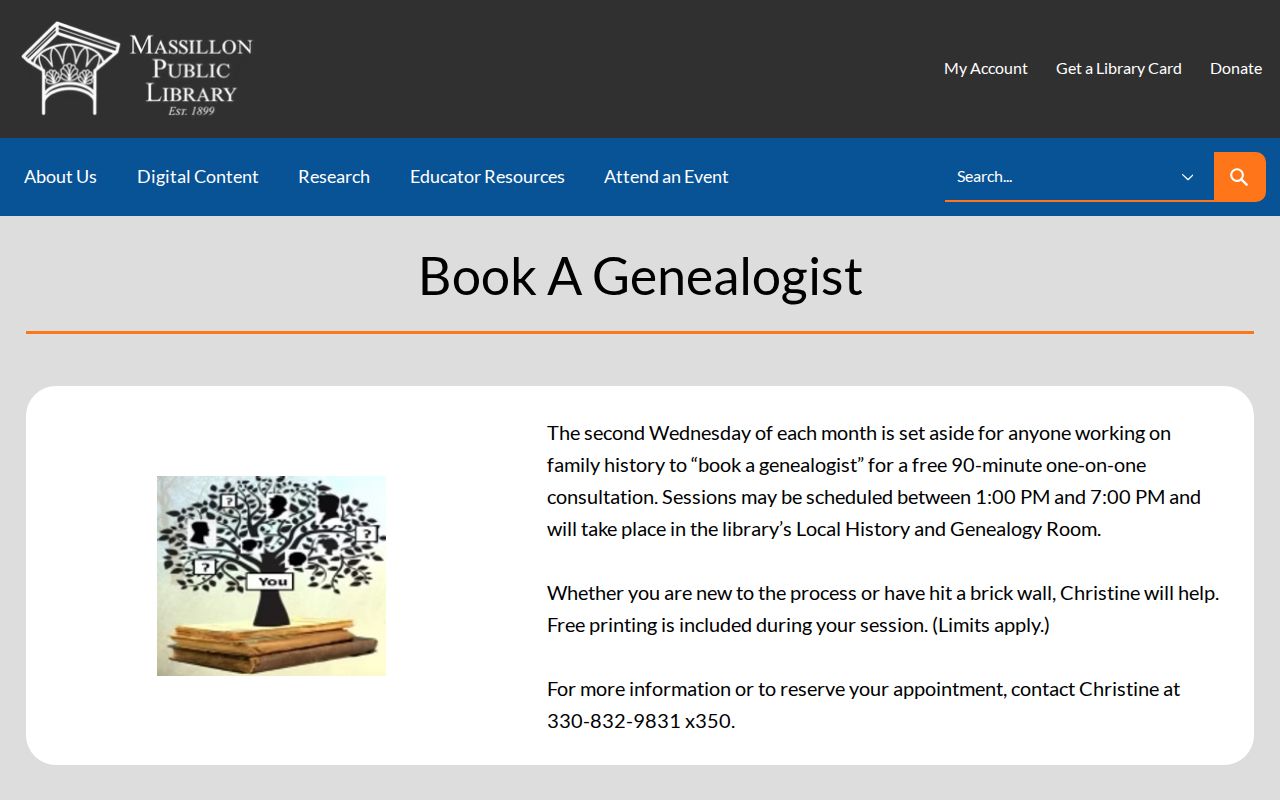
Staff help shines when a run has a gap or a listing reads ambiguously. It cannot convert a partial digital shelf into a complete annual directory series, though, so plan some Massillon research for an in-person visit.
Massillon Directory Dates And Gaps
A city directory captures one publication date. It can place a name or business at an address near that edition's date. It goes no further. Moves, relationships, and ownership questions usually need other records. The 1940-45 Ohio Bell volume runs 356 pages with transcript searching. It also carries classified and business headings, product and service details, and cross-references. Those rich fields help. But they never justify adding spouse, owner, or widow facts the page does not actually print.
Massillon's record history explains why some work happens online and some in person. Digitization began through Ohio Memory in 2000. Rotch records were scanned and transcribed from 2001 through 2004, and a Massillon Memory portal followed in 2005. Support in 2010 completed further digitization and cataloging. Each collection therefore carries its own access path.
- 1859-1860: C. S. Williams published the combined Canton and Massillon directory guide.
- 1876-1877: Burch, Potter & Co. issued a combined directory.
- 1884-1945: selected Burch Directory Co. editions document a long, but not continuous, local run.
- 1922-1947: selected Ohio Bell volumes add telephone and city-directory material.
- 2000 onward: Massillon Memory's staged digitization made selected local records available online.
Note: A volume's publication date is not the date a family moved, married, bought property, or left Massillon.
Tracing Massillon City Directory Families
Begin with the first edition showing a name or address. Then work one available edition earlier and later. Copy the spelling, street wording, page, title, publisher, and any visible symbol exactly. Pair that sequence with the public federal census releases through 1950 rather than letting a directory stand in for a census household. A census is tied to its enumeration date. A directory is tied to the publisher's issue date. A deed records a transaction or an ownership interest.
- Locate the first verified surname or address in a dated Massillon directory.
- Check the next available earlier and later editions for the same spelling and nearby variants.
- Use a Burch street page when the address, rather than the surname, is the starting point.
- Compare the nearest 1920, 1930, 1940, or 1950 census release for a dated household snapshot.
- Use an obituary, probate record, or deed only for the different event it documents, and retain conflicts.
A vanished name may mean a move, a death, a changed listing practice, or a plain omission. Preserve that uncertainty in your notes. When the question shifts from a historical household to the chain behind one property, the Massillon past residents record trail offers the address-focused follow-up.
Massillon Museum House Research
The Massillon Museum adds a different layer to directory research. Its Erwin Research Room is appointment-only. General archive requests may take up to four weeks. Holdings include historic business files and Chamber photographs from the 1920s through the 1980s. The collection also holds street-indexed house photographs, blueprints, and other archival materials. For directory and genealogy questions, the Museum points researchers to Massillon Public Library. It notes that annual directories sit at both institutions, and some have been digitized by MPL. The Museum's research archives information appears below. It works best when a family history needs physical or architectural context. That context can matter more than another name listing.
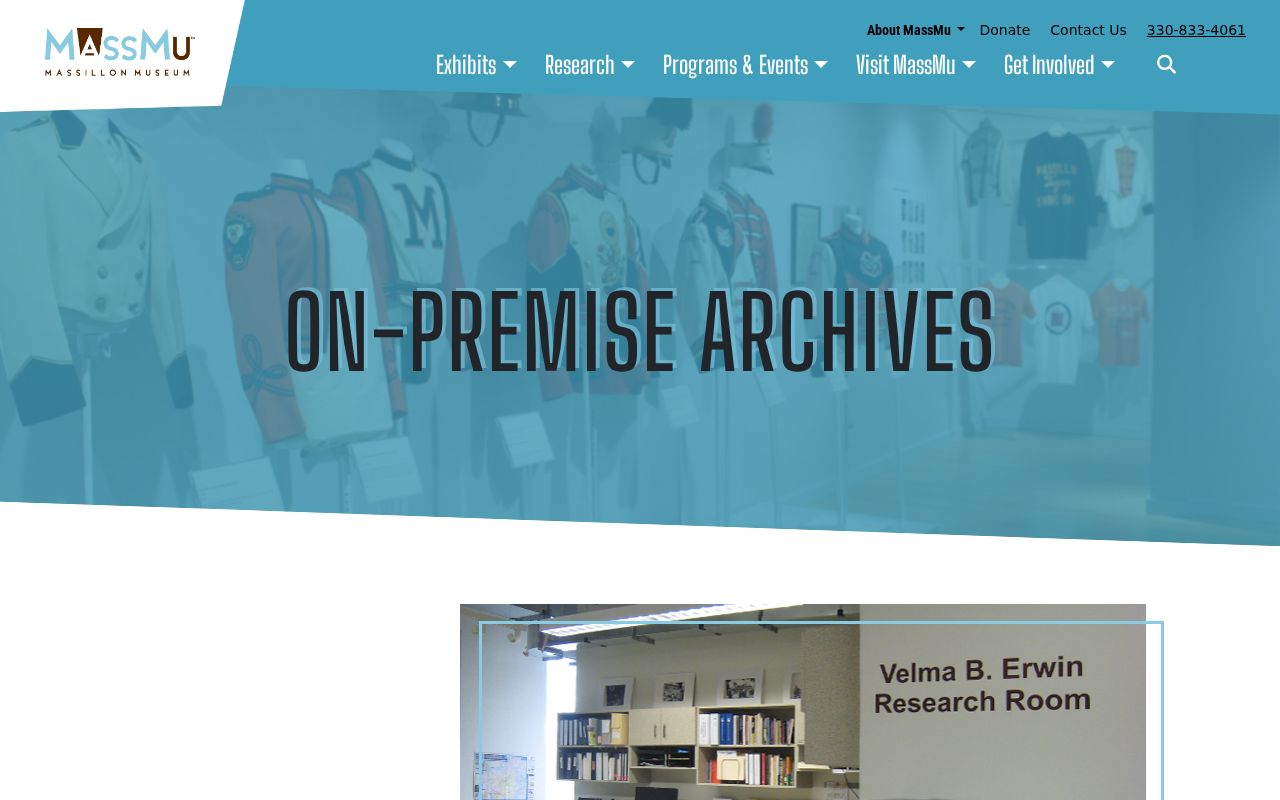
The Museum describes more than 600 blueprints plus house photographs listed by street. Those resources can help date or identify a building feature. They cannot prove that a particular person occupied a property.
Note: A Museum request can describe a structure's history. It should be compared with a dated address record.
Massillon Directories In Local Context
Massillon's early names and shifting geography matter when an old title confuses you. City history places Kendal in 1812. Massillon was recorded in 1826. Its port period came in 1828. The unified city incorporated in 1853. Old State Road later became Lincoln Highway. A police-history reference identifies a 1920 location at Tremont and Duncan, now 6th S.W. Keep those older forms in your notes. Test them against a parcel or legal description rather than trusting a modern street search to recognize them.
Repeated annexations create another boundary problem. A historic mailing may cite Massillon. But it may not match today's city or township geography. The City describes its historic setting as developing around river, canal, rail, and industrial locations. That mix helps explain why one directory volume combines household, business, and classified information. Treat it as context for the publication. Never use it as a basis for claims about an individual.